Meet D-Box:
Where Awesome Begins!
- HOME
- What is D・Box?
- Meet D-Box: Where Awesome Begins!

An Innovative Ground Improvement Method Contributing to Eco-Friendly Development and National Resilience.
D・Box method offers a rational and innovative solution for ground improvement,
leveraging original technology to enhance soil performance effectively.
Point1
A Groundbreaking Technique Delivering Multiple Effects
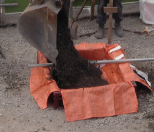
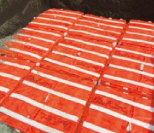
By drawing out the natural potential of the soil and densifying the underlying ground, the D・Box method significantly increases bearing capacity and reduces settlement. This enables effective reinforcement of soft ground and provides countermeasures against vibration and liquefaction.
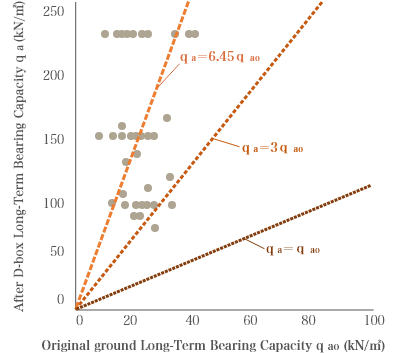
Tripled Long-Term Bearing Capacity
Despite being a shallow improvement method, D・Box substantially enhances bearing capacity.
(Figure: Comparison between long-term allowable bearing capacity of untreated ground and plate loading test results)
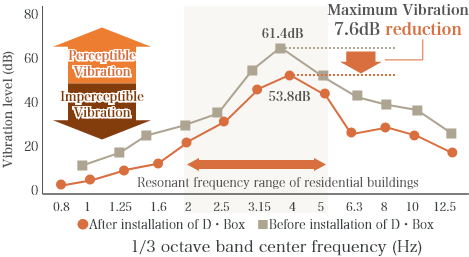
Reduces Ground Vibrations
by 5–10 dB
Installing D・Box within roadbeds markedly mitigates traffic-induced vibrations. Furthermore, placing it beneath building foundations reduces not only traffic-related vibrations but also seismic motion.
Point2
Environmentally Conscious, Contributing to Mitigation of Global Warming
D・Box method strengthens the ground without the use of cementitious stabilizers, making it a revolutionary eco-friendly technology.
Simply adopting D・Box in place of conventional methods contributes significantly to the reduction of greenhouse gas emissions.
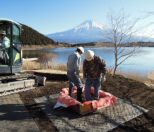
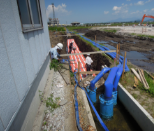

Comparison with Cement-Based Methods
Up to 95% Reduction in CO₂ Emissions
The manufacture of cement and steel generates large quantities of CO₂. Even for ground improvement beneath an average residential building, the emissions are equivalent to the combustion of approximately 4,300 liters of gasoline.
Free from Harmful Substances such as Hexavalent Chromium Superior Environmental Safety for Use in Agricultural Areas

Cement-based improvement methods require careful attention due to the risk of hexavalent chromium contamination. D・Box eliminates this concern entirely as it does not involve any cementitious materials.
Permeability Maintains Natural Groundwater Flow
Prevents Disruption of Groundwater Movement

Water plays a crucial role in many natural disasters such as landslides and embankment failures.
D・Box exhibits permeability equivalent to that of sand, ensuring that groundwater flow is not obstructed—an essential characteristic for disaster risk reduction.
Point3
Structural Integrity and
Ease of Installation
D・Box is made of high-strength materials and allows for flexible application across a wide range of site conditions, ensuring ease of installation.
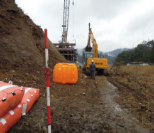
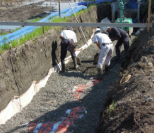
The fabric of D・Box is made of polypropylene (UV-Resistant Polypropylene) – Semi-Permanent Durability Underground
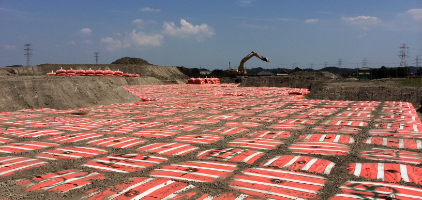
D・Box is fabricated from polypropylene (PP), a material with excellent chemical resistance and high strength. In underground conditions where UV exposure is absent, the D・Box maintains its mechanical integrity over the long term(UV protection measures are also applied for durability).
Proprietary Internal Structure Ensures Shape Retention and Strength

The internal components—such as guide gauges and truss bands—serve as restraining mechanisms, enhancing both strength and stability.
Filter Effect of the Container Yields Multiple Functional Benefits
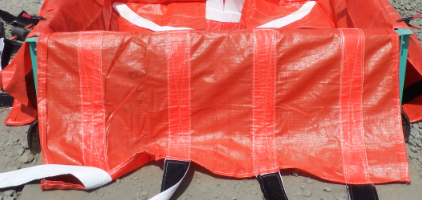
The fabric of D・Box permits water to pass while blocking soil particles, resulting in significant benefits for ground reinforcement and liquefaction mitigation.
Compatible with Small Equipment and Manual Labor

The system does not require specialized machinery and can be installed using compact equipment—or even manually—making it ideal for narrow or otherwise challenging construction sites.